

👇 TL;DR: This Week in The Digital CEO Weekly 👇
✅ The #1 skill that gives you more peace, clarity and certainty in your business (spoiler: it's not another strategy).
✅ Numbers don't lie. Learn their language and they'll tell you exactly what's working... and what's leaking.
✅ The handful of metrics every Digital CEO must track to get a true read on your performance (and how to actually measure them).
From the Desk of James Wedmore:
Growing a business is simply about deploying particular skills in an effective way in order to produce results.
Marketing, sales, communication and teaching are all skills.
Because they are all labeled as skills, it means you can get better at them. Practice... experience... improves the skill. When you get better at these skills, you improve results.
All of these skills are essential to your business success, but there’s one unique skill that I don’t hear many people talking about, which is truly one of the most valuable skills we can ever have in business.
And that is the skill of "getting to the bottom of it."
The skill of diagnosing the problem.
The art of interpreting data and successfully identifying the cause for a lack of results or performance.
Because the reality is: you can’t make the right changes or decisions if you don’t get to the root cause of the business breakdown.
In this week’s newsletter, I wanna share with you a few distinctions that can assist you in becoming a better "Business Whisperer" so you can get clear on what caused a performance breakdown.
Let’s start with a simple principle:
Business Principle 1: There is a Cause For Every Effect
For anything that is broken, or doesn’t work or perform at the level it should’ve, there is a cause or reason.
There can also be multiple causes. These causes could be external to the marketplace or internal to you and your energy. They could also be relating to broken pieces in your strategy.
Before we identify what it is, it’s important to remember that there’s always a cause for every effect.
Which takes us to the second business principle:
Business Principle 2: For Every Problem, There’s Always a Solution
If something in our business caused a “problem", there must also be a solution. But again, we can’t get to the solution without successfully identifying the cause.
Learning the Language of Numbers
We also can’t go any further in this process until you are consistently and accurately reporting and documenting your numbers.
Every number is trying to tell you something. It’s speaking to you. But for most, this is a new or foreign language. We must learn the language of numbers so we know what they are trying to tell us.

The mistake that most newbie entrepreneurs make is they only look at one number: sales.
"How much moola did I make?!"
But sales is the effect of several different moving pieces.
For example: first there was an audience, then there was an invite, a click, a page visited, a page opted in to, a video watched, a webinar attended, a sales page visited, a checkout page that was filled out... all completed in that order WAY BEFORE the sale was ever made.
This is a total of 9 different steps. And each step is an invite to keep going... or drop off.
WHERE people drop off is where you have performance leaks. And only your numbers can tell you where there was a drop off.
So the first place we always look is in percentages.
You can only measure a percentage when you have two numbers. Two numbers like unique visitors and unique opt ins.
100 people visit a landing page of yours and 10 opt in. That’s 10%.
Yay math. #rocketscience
These percentages match up against industry guidelines and start to paint a picture determining if we’re coming in hot or way underperforming.
These guidelines are specific to industries and different strategies. So you must know your strategy first.
I'll use a webinar launch strategy as an example here.
You can plug in any sales strategy that you’re using, but you must understand the steps, which for a webinar are as follows:
✔️ Invite
✔️ Register
✔️ Attend
✔️ Purchase on webinar
✔️ Purchase after webinar
Each of these are specific events that occur in a sales strategy. And each of these can have a percentage performance metric attached to them.
The higher the metric, the higher the sales. Simple.
So when you run your sales system and track your data, re-launching the same strategy and improving the lowest percentage points will help grow sales.
This is why I tell my students that everything you want from your business is on the other side of what you replicate.
It’s silly to think people wanna do one launch and hit a home run, especially when they’ve never launched before. But my students master their sales when they repeat the process, improve skills, understand their data and make adjustments accordingly.
That’s the only way this works.
So let’s break down a few of these so you can see them in greater detail.
Invite:
We can measure performance in whatever content medium we’re using for the invite.
Maybe it’s Instagram, an email or an ad.
We’re measuring the percentage of people that saw the invite versus clicked. And again - the higher the percentage, the better the performance.
To get more specific: if I invite you to a webinar via email... I can track TOTAL SENDS to TOTAL OPENS (Open Rate) as well as OPENS to CLICKS (Click Through Rate).
These numbers tell me how my subject line is doing, how my email copy performed, and even where my audience is in relationship to me and the topic! And as I've said: increase these numbers... SALES increase too!
Register:
Here we are documenting the performance rate of the registration page itself. This is your landing page. Your opt-in page. What percentage of page visitors opted in?
This is one of the most vital metrics to track.
Why?
Split testing simple headline changes could take a conversion rate of 20% to 35% overnight, and when you’re sending thousands and thousands of visitors to that page, we’re talking about hundreds of thousands of dollars in potential growth.
There’s many schools of thought on what a good guideline is for landing pages, and nothing is set in stone, but I’ll say this:
If you have a landing page converting less than 20%, it needs a lot of work.
I believe the highest converting landing page I’ve ever seen in my business was 64 to 68%, so if you’re falling somewhere in the 25 to 35% range, you deserve to put that one on the fridge.
Attend:
Now like I said, every strategy is different but for a webinar, we want to track attendance rate.
I think it goes without saying that the more people that attend your webinar, the more prospects you have that can buy from you. So if less people attend, you have less sales.
Tracking your attendance rate and then testing different strategies to increase attendance rate will lead to more sales.
Again I try to avoid giving detailed guidelines, but if you have over 20% attendance rate, you’re moving in the right direction. The goal would be 30% or higher.
Purchase on Webinar:
Next we can track sales made on this webinar. And to calculate that, you just divide total units sold divided by total attendees.
Purchase After Webinar:
Then you can track sales made post webinar by registrants.
I like to know what percentage of my sales came on the webinar versus after.
Why?
Because even in a 4 to 7 day follow up sequence before you close the doors down, there’s such an opportunity to address more objections and offer conversion triggers that will increase sales, so why not take full advantage?
Post strategy numbers that matter most
Now, if what I just went over starts to make your head spin a little, I get it... but get used to it. Because this is business.
And... There are two metrics that I always look at which measure the overall performance of the sales system itself, and those two metrics are:
✅ Sales Conversion Rate
✅ Earnings Per Lead
These two metrics measure the overall performance of the sales system.
Sales Conversion Rate is calculated by taking total units sold divided by total registrants into the sales system.
We see anywhere from 3 to 15%. It depends on the offer, the sales system and the market. But if you’re doing less than 3% something needs work and we look at those other metrics that I already went over to determine where the leaky profit holes are.
Example: If I made 10 sales off a webinar where 500 people registered, I have a 2% conversion rate (10 divided by 500).
The last metric and my favorite metric, Earnings Per Lead (EPL), is calculated by taking total revenue divided by total registrants or leads in a given launch or promotion.
So if I made $10,000 off 500 registrants, I have an EPL $20.
Again, depending on the offer and market, I like to see an EPL over $20.
But what I want you to think about is this: EPL is measuring what a lead is worth to you in your business. In this case, every lead or webinar registrant is worth $20, and if I had one more lead join, I would’ve made $20 more.
This is important, not just because it measures the performance of the launch (the higher the EPL, the higher it performed), but it’s the metric that gives you a ton of ease or peace of mind when you go to scale.
Because scaling with paid advertising is simply a game of buying leads.
People are afraid to invest in ads because they don’t understand the game. You are just buying leads, and if you buy leads for less than what they’re worth you have what is called a profit. Yes!
So if I have an EPL of $50, i.e. each lead is worth $50 in that launch, I have no problem spending $5 to $10 to acquire more leads.
That’s when you realize the more I buy, the more I make. Yes.

The last metric I'll really leave you with is a fun one that I don’t really have a name for, we could call it Earnings Per Subscriber.
This is a macro-level number that I like to track with my clients and it’s total annual revenue divided by total leads on your entire email list.
For example, if you made $250,000 last year and you had 10,000 subscribers on your email list, you would divide the two and get a number.
This number tells you how well you are selling in comparison to list building.
If the number is low, you’re not really converting your leads.
If the number is high, that’s wonderful, and there’s a huge emphasis that you should make to continue growing your email list.
Other metrics to track
This can quickly become a double-edged sword. You can start tracking everything and go a little crazy getting lost in all the numbers. My best advice is to always keep your business simple. And the simplest approach is: TLC, or...
Traffic. Leads. Customers.
The example I went through with the webinar launch is a sales strategy. So it’s tracking leads and sales. What it’s not tracking is traffic or audience growth. And we need to be focusing on that as well to continue growing.
So if you have a primary platform, social media or ad strategy, pick one to two metrics that are worth tracking. And not just any metric - metrics that matter most and tell the clearest picture of what’s working and what's not.
➜ If you’re using Facebook ads, how many leads at what average cost did you acquire this week?
➜ If using Instagram, how many new followers? How many leads were generated from Instagram?
➜ If doing a podcast, how many downloads this week and leads from the podcast?
➜ If doing YouTube, how many views and leads?
You get the idea. You track these, you document them overtime and you test and tweak your strategies to see improvement and progress.
Now you’ve tracked every piece of your funnel.
We’re here to get traffic, turn that traffic into leads, and turn leads into sales.
Your numbers simply tell you where you're leaking. Where you’re dropping the ball and if percentages are too low, it’s pretty apparent where the leak is.
And going back to how I started this newsletter: for every problem, there is a solution. Your first job is to diagnose the root cause.
People believe Walt Disney - that there is a simple happily ever after in your business.
There is not.
More often than not is that something that once worked will stop working. Things will change. Things will be great one month and bad the next.
People have all these expectations and attachment, going into a total tailspin because something stopped working or didn’t do the same as it used to.
It’s called life. It’s called business.
That’s why the skill is so essential.
Expect things to break. Expect things to change. To stop working.
Your job is to master your ability to diagnose the problem so you can fix it with ease. If you can master that skill, you will always have a thriving business and you will operate business with more peace, clarity and certainty.
You will be in the driver's seat.
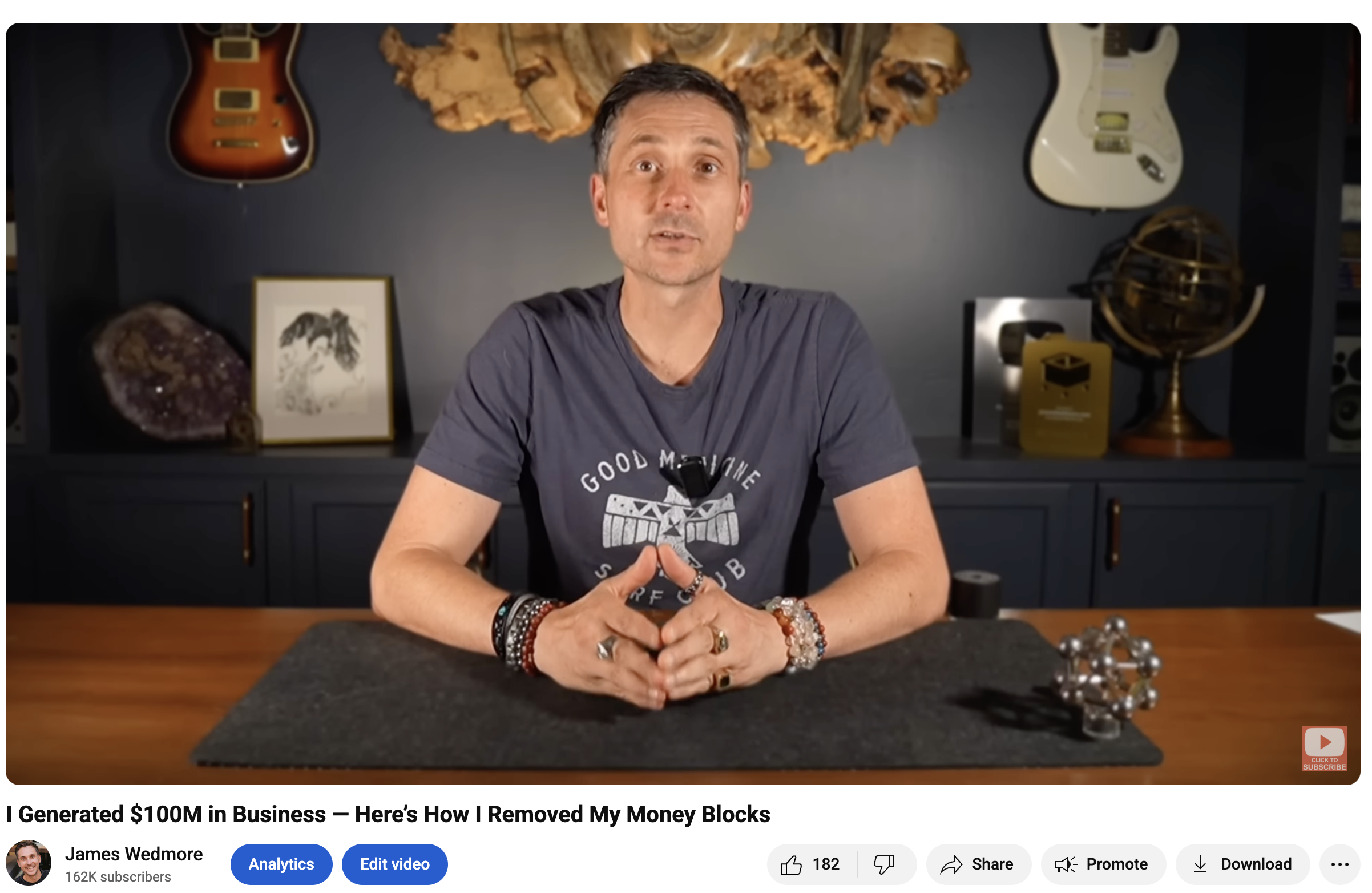
I Made a Video... And It's All About Money
I miss YouTube. I LOVE making videos, so I decided, why not?!
Here's one on how I transformed my relationship with money - have a listen and enjoy!
https://youtu.be/TX83gRDjzHE?si=Yd0o77g9bvBa3xji
This Week on The Mind Your Business Podcast
How an 8-Figure-a-Year Entrepreneur Thinks About Money
And if you want to dive deeper into the Money Mindset Conversation... join me on the podcast as I talk ALL about the money blocks and beliefs that hold people back.
This Week In A Meme