

TL;DR: This Week in The Digital CEO Weekly
✅ If your business feels heavier than it should, it might be a structure problem, not a strategy problem.
✅ My rundown on how to structure your org chart so that it stops creating friction and starts creating momentum.
From the Desk of James Wedmore:
I posted a video on YouTube a few months back about my 8-figure operating system... and it sparked a ton of conversation. And one question kept coming up again and again:
“How do I actually structure my team and business so it runs efficiently?”
Great question. BIG question. Lots to discuss but I'll try to keep it as concise as I can today. And this is something that a lot of businesses struggle with. Because if your business feels like it’s “working”... but also feels exhausting, fragile, or harder than it should be – I want you to hear this clearly:
Most likely…
You don’t have a motivation problem.
You don’t have a strategy problem.
You don’t even have a growth problem.
➡️ You have a structure problem.
I see this all the time.
From the outside, the business looks fine. To everyone else, you're lookin' goood! Yet something about the way it’s running feels off.
The boat may be floating, but it's also full of holes!
And that’s where things can get sticky. Especially when your intention is to grow and scale the business.
Because the instinct at this stage is usually one of two extremes:
-
Burn it all down and start over
-
Chase the next shiny strategy to “save” things
And honestly, both options rarely create a healthy, scalable company.
So… what actually does?
Structure. Clarity. Ownership.
And that starts with how you run your business quarter by quarter, role by role, and metric by metric.
So in this newsletter, I’m gonna walk you through exactly how I look at this.
Everything I’m sharing here is adapted from what’s taught in Gino Wickman’s book, Traction – a book I recommend every entrepreneur read.
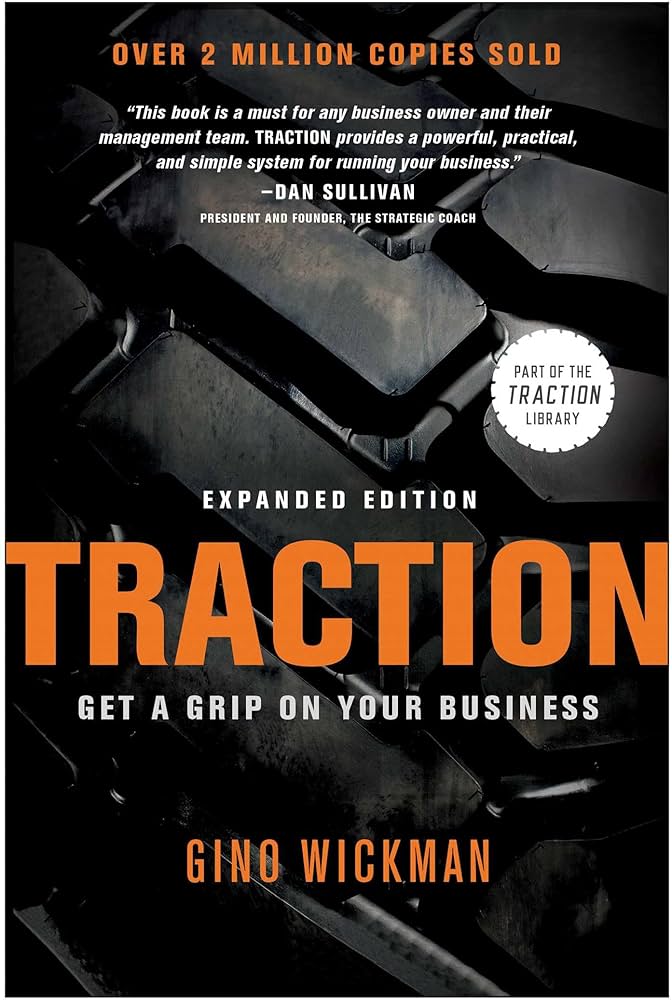
We’ve been using our own modified version of Traction inside our company for years – refining it, stress-testing it and making it work for a real, modern digital business.
So let’s get into it.
The 90-Day Framework
One of the biggest mistakes entrepreneurs make is trying to fix everything at once.
New messaging. New offers. New ads. New content. New org chart. New systems.
That’s how you sink the boat.
Instead, I run everything from a 90-day framework – and I believe every business should do this too.
Each quarter gets four clear components:
-
A revenue outcome: What do we want to produce in revenue? This is the anchor.
-
The offer: Revenue only comes in if something is being sold. Period.
-
The promotion plan: How is that offer being sold? A launch? Webinars? Ads? Etc.
-
1-2 internal cleanup projects max: This is where most businesses go wrong. They try to overhaul everything internally while also pushing growth.
You don’t need to fix the entire business this quarter. You need to focus on fixing just ONE thing... one thing per quarter.
That’s why internal overhauls are typically an 18 month to 3 year process… not a weekend project.
So this quarter might be:
✔️ Reworking your org chart
✔️ Clarifying roles and attaching metrics
And next quarter might be:
✔️ Cleaning up expenses
✔️ Improving systems
This is how you create sustainable momentum instead of chaos.
The Org Chart: Roles First, People Second
Once the 90-day framework is in place, the next thing I look at is the org chart.
And this is where almost everyone makes the same mistake. They write down people’s names first, and then the role they’re CURRENTLY doing.
That’s backwards.
You do not start with:
“Susie does this. Michelle does that.”
You start with:
➡️ What roles actually exist in this business right now?
Not future roles.
Not aspirational roles.
The roles required to run the business TODAY.
Think of it as putting the seats on the bus – not deciding who sits in them yet.
When you do this honestly, you often realize:
-
You’re sitting in multiple seats
-
Some people aren’t actually sitting in their seat
-
Some seats shouldn’t exist anymore
-
Some critical seats are missing entirely.
This is where clarity begins.
Metrics: Every Role Owns a Number
Here’s where performance either skyrockets… or falls apart.
There must be a metric attached to every role. In other words, every role must OWN a metric.
Not “help with”, “support”, or “assist”.
Own.
When someone owns a metric, they are responsible for it, just like owning a dog. If you own the dog:
-
You feed it
-
You train it
-
You deal with the consequences
Entrepreneurs say they give ownership… but they often take it back by micromanaging, double-checking or doing the work themselves.
That’s not ownership. That’s control disguised as leadership.
When a role truly owns a metric:
✅ Expectations become clear
✅ Performance becomes measurable
✅ Conversations become objective
And suddenly, a lot of “people problems” disappear. Because most performance issues aren’t character flaws – they’re clarity problems.
Now you might be asking “what if multiple people contribute toward a task? Who owns the metric then?”
Let me start by saying that one person can absolutely sit in more than one seat. But two people can NOT sit in the same seat owning the same metric.
There is one role that MUST own the metric. Whoever the manager is. The other supporting roles are “technicians”.
Managers own outcomes. Technicians execute tasks.
Let’s use podcasts as an example. There’s a podcast manager, a podcast editor, and maybe a VA or software tool all involved in getting episodes out each week.
A podcast editor, VA or software tool does not own a metric. They own completion of their task and timeliness.
But the podcast manager owns the number.
If someone owns podcast downloads, everything else aligns underneath that:
✔️ Booking guests
✔️ Successful recording, editing, and uploading
✔️ Promotion strategy
✔️ Social distribution
One metric creates focus. Focus creates results.
GWC: Get It. Want It. Capable of It.
Once roles and metrics are clear, I bring in Traction's GWC framework:
-
Get it – Do they understand the role?
-
Want it – Do they actually want to do this role?
-
Capable of it – Can they do it at the required level?
If any of these are missing, something has to change.
Sometimes that means:
-
The right person is in the wrong seat
-
The role needs to be redefined
-
The person needs more training
And yes… sometimes it means the wrong person is on the bus.
But GWC removes emotion from the decision and replaces it with clarity.
Now I want to mention Core Values and how they play a role too.
The Core Values of your company determine if someone BELONGS on the bus. GWC determines if they’re in the right seat.
You can have an amazing human who fits your culture perfectly… and still be misaligned in their role. That doesn’t make them bad. It means leadership hasn’t placed them correctly.
And as the business grows, seats can change.
That’s normal. That’s growth. That’s leadership.
Training Phases: Learn It. Maintain It. Grow It.
Okay, now that we’ve gotten seats AND people clear, let’s talk about training.
When someone owns a metric, I set expectations through three clear phases:
-
Learn it – No growth pressure. Just learn the role.
-
Maintain it – Demonstrate consistency. Hold the number steady.
-
Grow it – Now we expand. Improve. Optimize.
These phases might happen over 90 days… or 18 months. It just depends on the role. But the timeline matters far less than the clarity.
If someone isn’t growing a metric, the conversation becomes obvious – and fair.
Profit Is Oxygen
There’s a reason why all of this is so important. Let me say this plainly:
Profit is the oxygen that keeps your business alive.
No one person is worth killing the business. Because when the business dies, everyone loses.
A healthy business doesn’t just make more money – it manages expenses, expectations, and ROI.
Every team role should produce 3-4x ROI minimum.
This is how you build something that lasts.
So if there’s one thing I want you to take away, it’s this:
Don’t fix everything at once.
Fix one piece per quarter.
→ Org chart
→ Metrics
→ Role clarity
→ Training
These aren’t sexy. They’re not flashy. But they’re the reason some businesses scale effortlessly… and others burn out.
This is how you stop duct-taping holes – and start building something solid.
And if you do this right, you won’t need to fire people.
Why?
Because people either rise to the expectations clearly laid out for them… or they opt out on their own.
That’s leadership.
I hope this helps! Thanks for reading.
-James
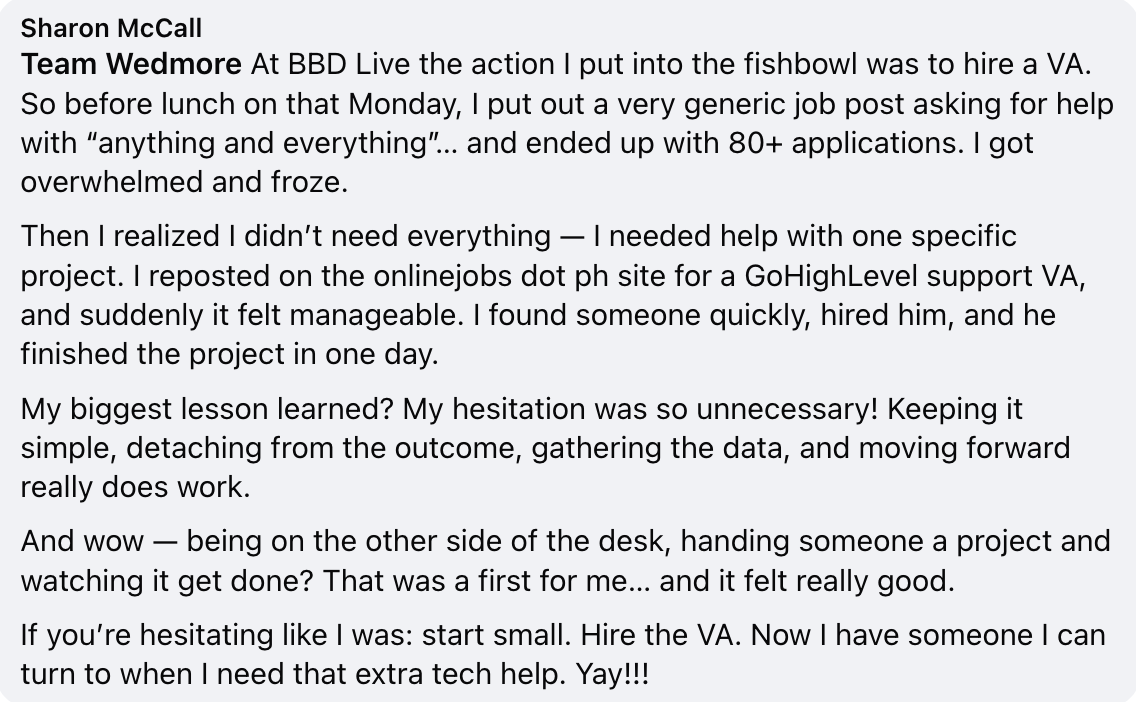
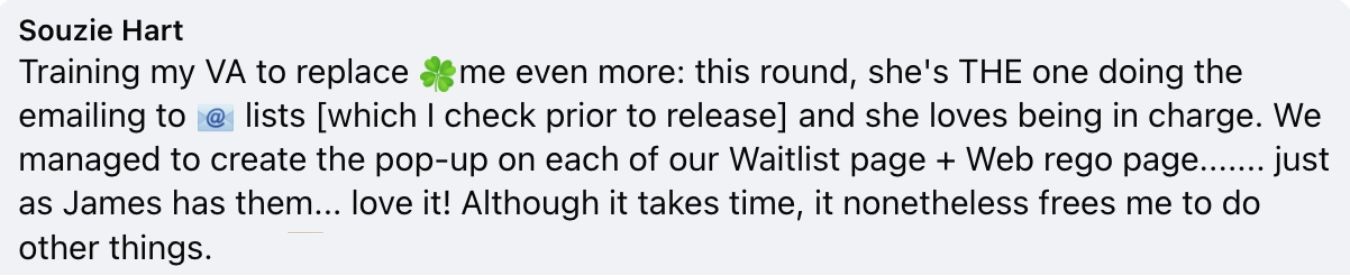
P.S. If this sparked a little "I know I need to do this..." feeling, you're not alone. Here are a few wins from BBD members who are sealing the leaks and building teams that actually support growth.

Once Your Org Chart is Set... Give Yourself The Promotion!
Once your org chart is clear and every role has true ownership – something interesting happens.
You get your time back.
You get your energy back.
And you finally get to step OUT of the day-to-day execution and INTO the role you were meant to play.
I talked about this in a reel we shared on Instagram from a podcast episode I recorded with Kajabi.
Click the video below to check out the reel... because this moment matters more than most entrepreneurs realize.
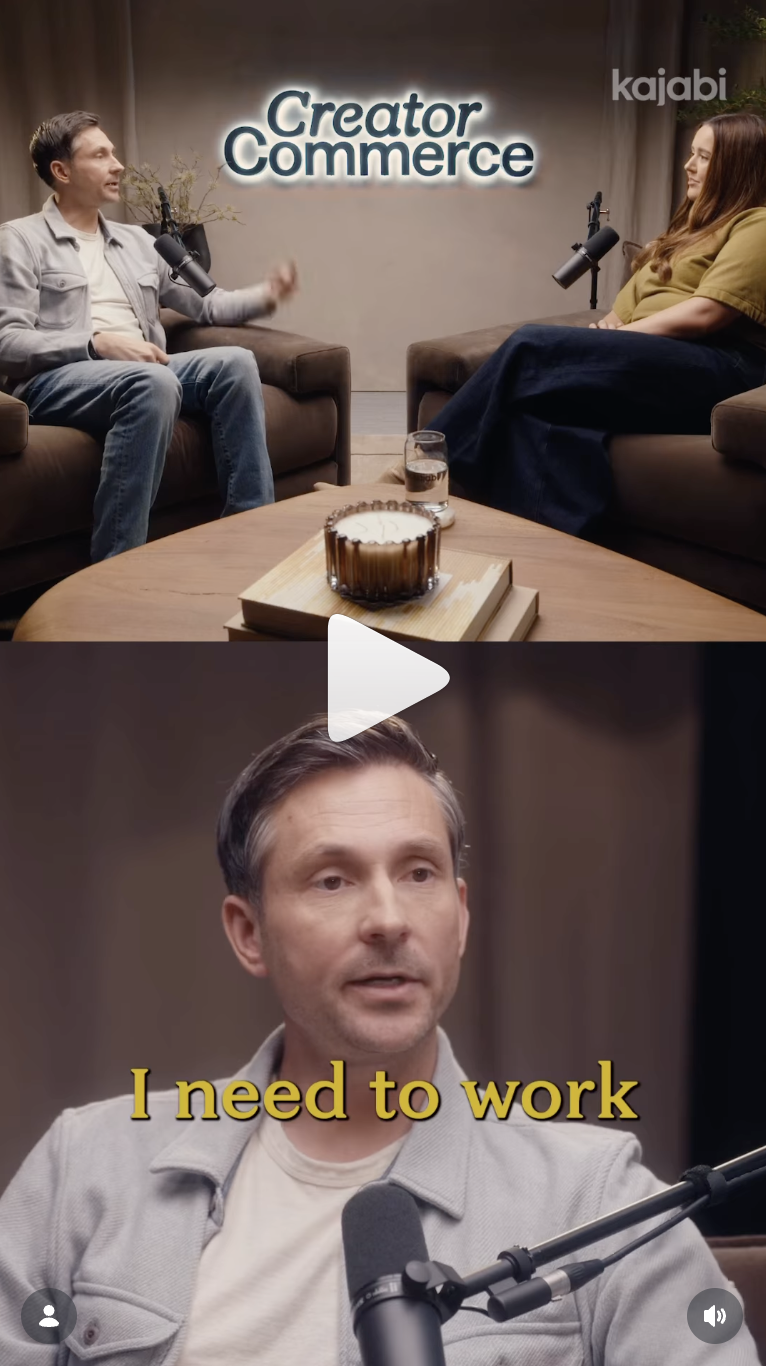
And if you wanna see the full episode where I zoom out and tell the bigger story of why so many entrepreneurs struggle to run healthy businesses in the first place, click here to watch now.
